 See Our Result
 - January 25, 2026
In approximately the last three years, Google Ads have changed more rapidly than they did in the previous decade. From automation and privacy restrictions to multi-surface ad delivery, Google Ads are now completely different from what they once were. Despite these upgrades, most brands are still relying on outdated budget allocation models.
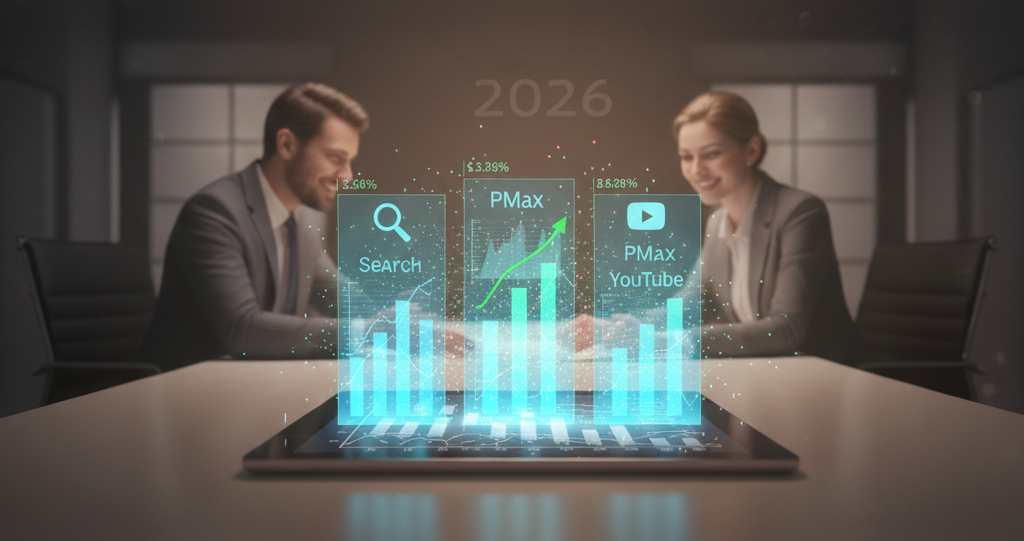
In 2026, effective Google Ads budget allocation is no longer about choosing one channel and maximizing it. It involves balancing Search, Performance Max, and YouTube in a way that aligns with how buyers actually discover, evaluate, and convert.
Most legacy Google Ads strategies were designed in an era where intent was easy to identify and track. That environment no longer exists.
For years, search campaigns were considered the safest investment due to high intent, clear attribution, and predictable ROAS. However, this approach has clear limitations in 2026.
Search-only strategies fail because:
Search does not create demand—it only captures it. YouTube and Performance Max play a fundamentally different role by introducing products to users before they actively search.
This drives brand recall, category awareness, and purchase consideration.
Brands that underinvest in demand creation and rely solely on search often increase budgets while seeing declining incremental returns. In 2026, budget allocation must reflect the full customer journey—not just the last click.
There is no foolproof budget split that guarantees profitability. Budget allocation must adapt based on brand maturity, margins, and buying behavior. No single model works for every business.
Early-stage brands typically have limited brand awareness and inconsistent demand.
What usually works:
Scaling D2C brands face a different challenge: maintaining efficiency while unlocking new growth.
Key considerations:
High-AOV brands (luxury, considered purchases, or B2C SaaS-like ecommerce) require longer consideration cycles.
For these brands, YouTube ads budget strategies are less about immediate ROAS and more about influence, recall, and assisted conversions.
Understanding the role of each channel is critical to correct budget allocation.
Strong Google Ads media planning assigns budgets based on channel roles—not just historical ROAS.
In 2026, very few conversions happen in a single touchpoint.
A typical journey may look like:
When performance is evaluated only on last-click attribution, YouTube and upper-funnel PMax appear inefficient and get cut—hurting long-term growth.
Effective Google Ads budget allocation accounts for assisted conversions and channel interaction, not isolated results.
The goal is not to chase short-term ROAS, but to build a system that sustains long-term growth.
In 2026, Google Ads success depends on understanding the role of each channel, aligning spend with business stage, and measuring impact beyond last-click attribution.
Brands that follow these principles are more likely to scale predictably and sustainably.
It depends on your business stage and goals. Most brands need a balance of Search, Performance Max, and YouTube.
No. It performs best when combined with Search and YouTube for full-funnel coverage.
Spend depends on product type and buying cycle. Higher-AOV products typically require more awareness investment.
Proper media planning ensures budgets drive both immediate conversions and long-term demand.
Yes. Sudden budget shifts can destabilize campaigns. Always adjust gradually.